Pump theory and characteristics, including types of cargo pumps and their safe operation
| Website: | Nautitec e-learning |
| Kurs: | test |
| Buch: | Pump theory and characteristics, including types of cargo pumps and their safe operation |
| Gedruckt von: | Gast |
| Datum: | Samstag, 29. August 2026, 13:38 |
1. Centrifugal Pumps
Operating Principle
A Centrifugal pump operates on the forced vortex flow concept. When a certain quantity of liquid is permitted to rotate by an external torque, a rise in the rotating liquid’s pressure head occurs.
Constructing a pump with high differential pressure and high efficiency within a limited space, faces challenges related to managing forces, fluid dynamics, and heat generation. The main difficulty lies in striking a balance between maximizing pressure increase per stage and maintaining efficiency.
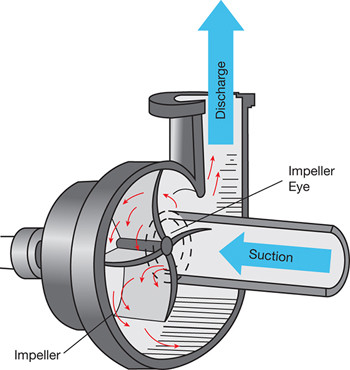
Centrifugal pumps are preferred as main cargo pumps on LPG carriers for several reasons:
1. Efficiency: Highly efficient in handling fluids at different flow rates and pressures.
2. Maintenance: Simple design with fewer moving parts compared to other pump types, making them easier to maintain and less prone to breakdowns.
3. Safety: Considered safer for handling volatile liquids like LPG because they generate less heat/friction during operation and have no dynamic seals, minimizing the risk of sparks and potential ignition.
4. Adaptability: These pumps can handle various viscosities and are versatile enough to accommodate different cargo requirements.
Types used on board of LPG carriers for Cargo transfer are Deepwell, Booster and Submerged Pumps. They may operate in series or in paralell. For example Deepwell in combination with Booster pump or a cargo heater. Each type comes with its own set of advantages, disadvantages, and specific construction characteristics.
2. Centrifugal Pumps
To address the limitations of centrifugal pumps, manufacturers employ various design modifications:
- Improved Design and Materials: Advancements in pump design and the use of high-quality materials enhance efficiency and durability. Optimization of casing designs, and materials to improve performance with different fluids and operating conditions.
- Multiple Stages: Pumps are utilized to increase pressure capabilities by using several impellers in series, allowing higher pressure outputs. Each impeller stage helps to distribute the pressure increase across multiple smaller increments. This minimizes the stress on each individual stage and allows for more efficient energy transfer.
- VFD (Variable Frequency Drive) Control: Implementing VFDs allows variable speed control, improving pump efficiency by adjusting to changing flow requirements and minimizing issues associated with varying flow rates.
- Cavitation Reduction Measures: Techniques such as improving inlet designs, maintaining proper suction conditions (Inducer), and adjusting operational parameters to mitigate cavitation risks.
- High-efficiency impellers are designed to minimize turbulence and energy losses within the pump.